
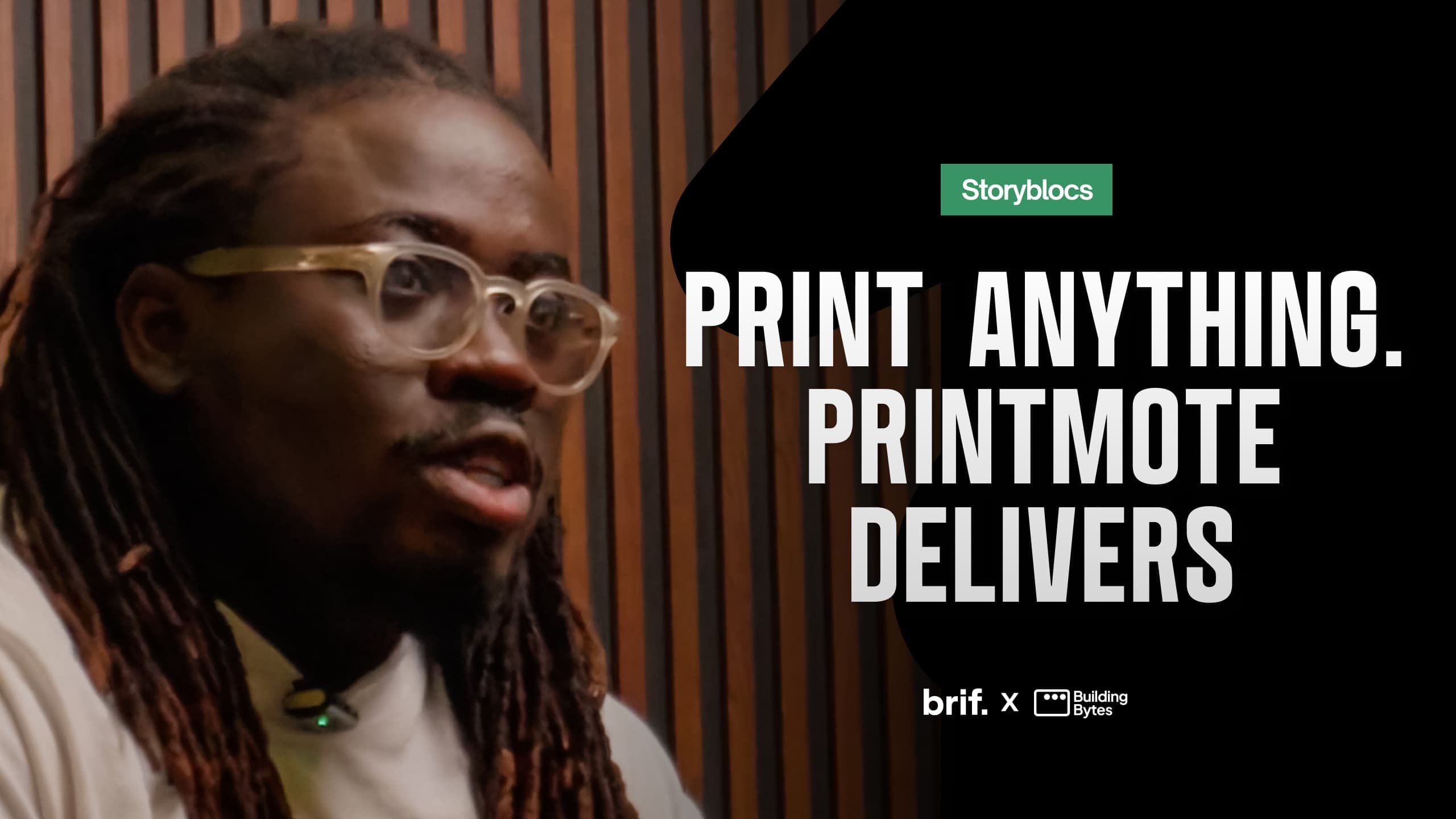
Yaw Antwi-Owusu remembers the sentence that started a company. He had left a print job with a vendor in Adenta, planning to collect it for a later event. When he came back, a staff member told him that if he left his item there again, the next time he came, they would have burnt it.
He was not a printer. He was a product and brand designer who, for years, had run events and watched every vendor category behave; food arrived, sound arrived, audio arrived, except one. Printing was always the crack in the plan. To get materials on time, he had taken to placing the same order across several shops at once, just to hedge. The threat in Adenta only confirmed a suspicion he had already begun to research: the problem was never the printing. It was that no one was accountable for his deadline.
A surplus that feels like a shortage.
The instinct is to assume Accra needs more printing or better printing. The numbers point the other way. A 2025 business-data count by Rentech Digital's SmartScrapers put Ghana at roughly 1,284 print shops, about 921 of them in Greater Accra alone, and nearly all of them, around 99%, single-owner operations. Capacity is not the scarce thing. What is scarce is any layer of accountability sitting on top of a thousand atomized shops, none of which will stake their name on a delivery date. Placing one job across five vendors and then chasing all five is not paranoia; it is the rational response to a market that makes no promises.
What Printmote actually is.
Founded in mid-2025, Printmote does not own presses. It coordinates them. A customer sends a job, most often over WhatsApp, and Printmote routes it across a network of vendors, manages the production, and delivers across Accra, presenting one interface and one point of accountability where there used to be many. Its central claim is a guarantee: if the output does not match what was promised, it is reprinted at no cost to the customer.
The company also worked out early who its real user is. Businesses rarely deal with printers directly; their designers do. So Printmote sells less to companies than to the designers who sit between them and the press, the people who feel the missed deadline first.
Why this isn't a random idea.
Antwi-Owusu is a MEST alumnus and a fixture in Accra's builder community, where he runs co-working meetups for engineers and designers. His framing for Printmote is deliberately larger than "we print fast": he describes the company as "the growth infrastructure of Africa's print economy." It is an ambitious line for a one-year-old business. It is also the frame that makes the model legible. Printmote is betting on coordination as a product, not paper.
The traction, by its own account.
Printmote says it crossed GHS 100,000 in revenue in its first year, with orders fulfilled weekly since April 2026, run by a lean, asset-light team. Its customers span event organizers, graphic designers, and businesses, both early-stage and established.
Whether the bet holds is the open question. A guarantee is powerful precisely because it compounds; every on-time delivery is a track record a rival cannot photocopy. But it is also the entire risk. An asset-light coordinator is only ever as reliable as the vendors behind it, and a reprint promise kept at ten orders a week is a very different thing from one kept at a thousand. Coordination tends to break at exactly the point where scale makes it worth doing.
Printmote has named the gap in Ghana's print economy more clearly than anyone. The market has yet to tell us whether one company can hold it.