
Agyei Michael Addai sent the money the same day he needed the shoes. A fellow student was selling them through a WhatsApp group, the transfer went through instantly, and then nothing did. He waited three days. There was no one to call, no way to hold the seller accountable, no refund to fall back on, just the hope that eventually the shoes would show up. They did, eventually. The powerlessness in between is what stayed with him.
"If that money had been held in escrow and only released once I confirmed the shoes arrived," Addai says, "none of that uncertainty would have existed." He later found out even a classmate in his own program was quietly running a similar side business. The frustration wasn't unique to him. It was structural, and it had an academic mirror. Students needing lecture slides or past questions were just as dependent on whichever course rep happened to feel like sharing that week, or whichever WhatsApp group survived someone's phone getting wiped.
Both problems, Addai realized, traced back to the same root: nothing had been built specifically for students. That realization became Uniloomy, a verified campus marketplace and learning platform now one of eleven finalists heading into the live pitch stage of the 2026 Moolre Startup Cup.
Two Years an Idea, One Year a Company
Uniloomy existed as a concept for close to two years before it existed as a product. Addai and his co-founder kept circling back to it in conversation while freelance and part-time work absorbed their actual time. The turning point wasn't a lightning-bolt moment, it was a decision, about a year before this profile, to take on fewer gigs and finally make room to build. "It evolved rather than started with one instant," Addai says. The company is currently in private testing on TestFlight and Play Store's closed testing, ahead of a public launch.
Who's Actually Underserved
The problem sits with a specific student: a first- or second-year at KNUST or the University of Ghana, living off campus or in a hall, drawing a monthly allowance from home that runs out before the month does. That student needs income and doesn't have a trusted, structured way to earn it as a student specifically. Before Uniloomy, the workarounds were scattered across WhatsApp groups, Jiji, Facebook Marketplace, and word of mouth, dealing with strangers there was no way to verify were even students. The same student is also chasing grades with no dedicated place to find materials, past questions, or someone a year or two ahead willing to explain a topic properly.
Addai's read on why this persisted is direct: general-purpose tools like WhatsApp and Jiji were never built for it. WhatsApp has no escrow, no verification, no way to organize by course or level, and everything disappears the moment someone loses their phone or leaves a group. Jiji verifies nothing about who's on the other end of a transaction. "No one has really taken a second look to treat students as a market worth building real, dedicated infrastructure for," he says.
What Uniloomy Actually Does
A student verifies their status once and enters a network connecting them not just to their own campus but to students nationwide, people distance would otherwise keep them from meeting. From there, they can list something to sell, post or find a gig, join a live study session, or pull free slides and past questions for their course. Money from any purchase or gig sits in escrow until the deal is confirmed complete, the seller gets paid only once the buyer confirms they received what they paid for. Activity on the platform also earns points called Looms, redeemable for airtime, data, or other sponsored rewards.
The hardest problem the team has had to solve wasn't the marketplace or the escrow logic, it was retention. Marketplace, gigs, and materials are things students reach for occasionally, when they need them. Getting someone to open the app daily for something that isn't purely transactional meant figuring out, through real iteration, what actually makes a student want to come back. "It's not just an engineering problem," Addai says. "It's a design problem."
The Moolre Layer
Uniloomy integrated three Moolre APIs: Collections, which powers the escrow flow by holding funds from every marketplace and gig payment until a transaction is confirmed; Disbursements, which releases those funds to sellers and gig workers once verified, and will eventually power Looms redemptions too; and SMS, used for verification and transaction alerts that reach students even when they're not actively checking the app.
The integration itself, Addai says, went smoothly, the harder work was on the financial side, not the technical one. Figuring out the right fee structure meant working out exactly what the mobile network takes, what Moolre takes, and what's left over for Uniloomy's own revenue model to make sense for everyone involved. That math took more back-and-forth than the API integration did. Without Moolre, the team would have needed to stitch together a payment aggregator for collections, a separate manual process for disbursements, and a third-party SMS gateway, more integration points, more failure points, and an escrow flow that would have been far harder to keep feeling instant and reliable. The one feature Addai wishes existed: a native escrow or split-payments API that automatically divides a single payment across seller, platform fee, and network fee the moment it's released, instead of Uniloomy managing that state manually across two separate APIs.
Twenty People, Four Teams
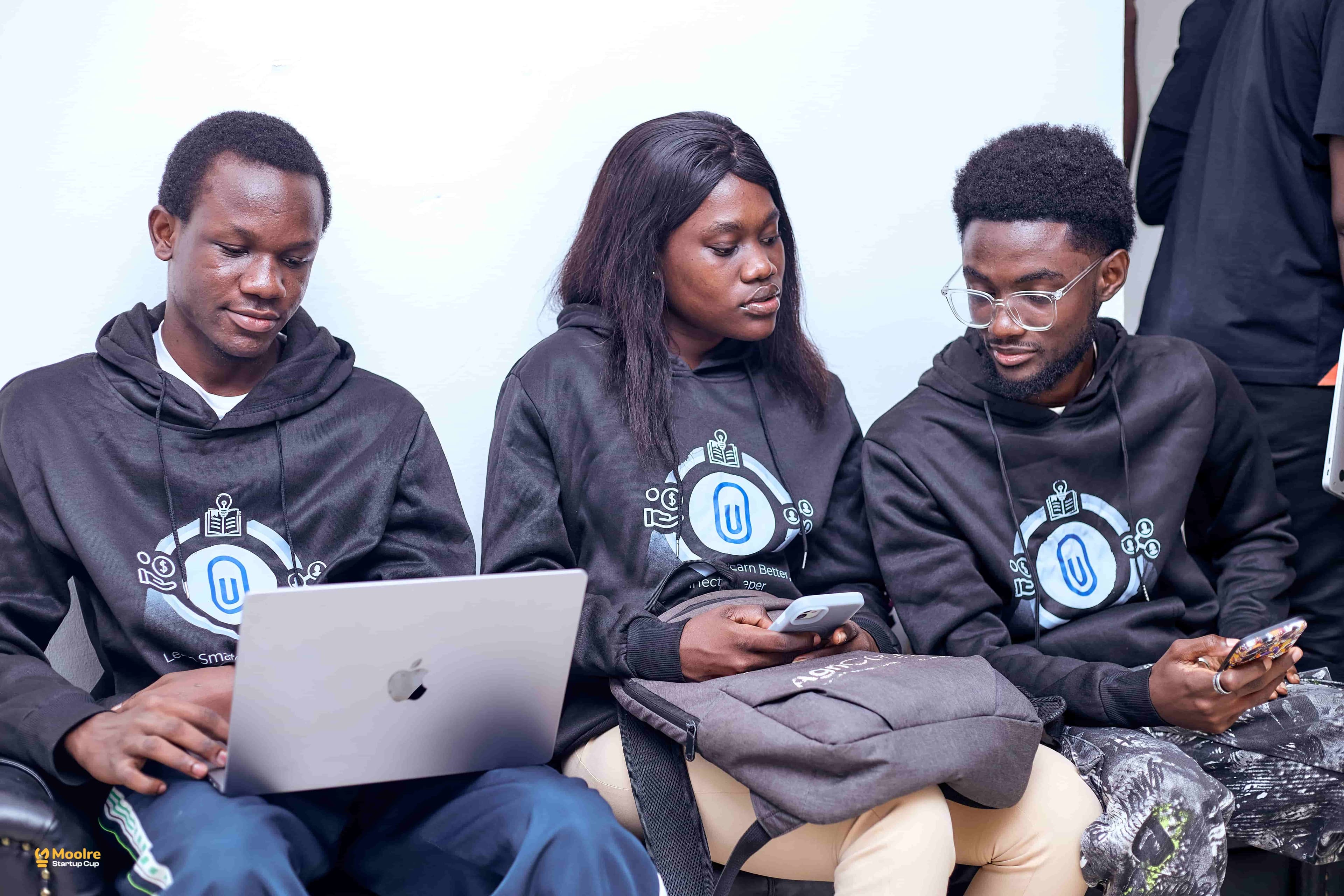
Uniloomy runs as a 20-person team: two co-founders, an engineering team of five including both founders, a design and media team of three who handle everything from UI/UX to the video content that produced the company's pitch video, a two-person news team handling campus-facing content, and a ten-person marketing and outreach team running community growth across the universities Uniloomy is targeting.
Missing the competition's top voting tier by just 13 votes, Addai says, came close to knocking the wind out of him, a painful margin given how much work had gone into the campaign. What kept him going was his team, who still believed in what they were building even in that moment, and the more than 7,000 people who voted for Uniloomy regardless of where it landed on a leaderboard, a number Addai reads as proof the demand was real independent of any ranking.
Addai credits a co-founder from an earlier venture, Debby, with shaping how he approaches building at all. He was the technical one on that team, purely focused on building and hoping people would use it; she pushed him to get out and test the market instead. "That lesson stuck," he says, "and it's shaped how I approach every project since." It's part of why the team pushed for 7,000-plus voters and built the product around what students actually told them they wanted, rather than what the founders assumed.
What's Next
Addai's broader read on what people get wrong about building in Ghana isn't about money. It's team first, execution second, and a real compensation plan third, funding, in his account, follows once those are in place, not the other way around. For Uniloomy, that means moving from private testing toward a public launch, continuing to build out the social and retention layer that turned out to be harder than any of the transactional features, and eventually layering in the split-payments infrastructure that would let the escrow system handle more than marketplace deals.
Uniloomy pitches live in the final stage of the Moolre Startup Cup, with winners announced at the Grand Finale on August 29, 2026.