
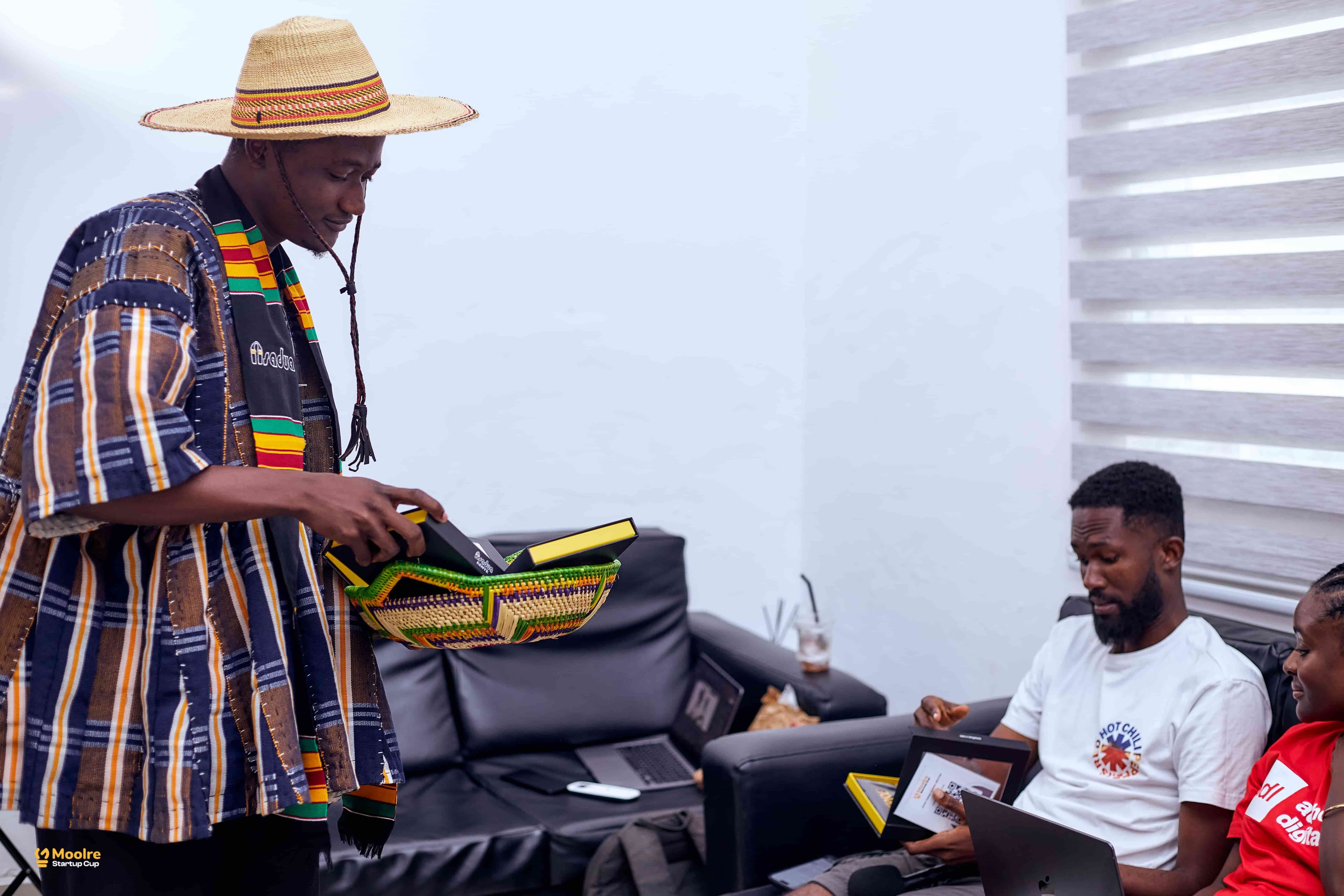
A supplier once sent John Aduko Anamboi's customer a photo meant to close a sale: a batakari, laid flat on the mat where it had just been woven. The customer looked at it and decided the piece must be fake. Nothing about the garment had changed. Only the frame around it had.
That single photo is the moment Anamboi points to when he explains what Nsadua is actually building. Not better crafts, Ghana already has those. A way to present them so a global customer believes what they're looking at.
Two Founders, Two Versions of the Same Problem
Nsadua's other half of the founding story belongs to Thomas Boakye Yiadom, who was already a working sash weaver when Anamboi met him. Yiadom had taken on more orders than he could fulfill, watched the pressure and anger from customers pile up, and instead of scaling back, dropped out of his fifth year of pharmacy studies at KNUST to fix the production side of the problem directly. What started as an effort to help sash makers produce faster widened, once the two founders looked past their own category, into something bigger: the same trust-and-presentation gap runs across Kente weavers, batakari weavers, and craft categories neither of them had originally set out to touch.
"The right people with the right skills and the right determination needed to have been in this market from the inside," Anamboi says, "experiencing the problems firsthand." Before Nsadua, he says, there was no real concrete workaround. Beyond isolated efforts like the Baba Tree Company in straw baskets, nobody had built dedicated infrastructure for the category at all.
What Nsadua Actually Does
A customer browses Nsadua's gallery, sashes photographed the way the founders wish every craft photo looked, worn by a graduate rather than laid across a weaving mat, and can customize a piece like a sash in 3D before placing an order. Status updates follow the order through production and delivery.
The hardest technical problem the team has taken on sits inside that production pipeline. Before a sash can be embroidered, custom text and logos have to be converted into DST format and digitized, work embroidery software can do but nothing built for Nsadua's workflow could do automatically, the moment an order came in. No API for it existed, so the team built its own. They have a working prototype; the stitching algorithm currently runs slower on the physical machine than they'd like, and Anamboi says they're still refining it.
An Unplanned Discovery: Nsadua as Pinterest
One feature the team didn't originally plan for turned out to matter most. After launching with sashes, customers kept sending in their own photos to be added to the gallery, and enjoyed customizing pieces in 3D enough to share the results with friends unprompted. Watching that happen pushed Anamboi toward a comparison he now uses to describe the whole platform: a Pinterest for African fashion, where browsing itself builds the trust the category has been missing.
The Moolre Layer
Nsadua uses Moolre for more than payments. WhatsApp handles promotional messages, SMS tracks customer orders, Collections processes payments, Disbursements pays artisans directly, and USSD lets artisans check their earnings without needing a smartphone or data connection. Without Moolre, Anamboi says the team would have needed Paystack for payments plus separate providers like Arkesel and Twilio for messaging, more vendors, more credentials, more places for something to break. The one feature he'd add: an API to buy SMS credit directly, instead of through Moolre's dashboard, so operations staff could manage the app without needing dashboard access themselves.
What's Next
Anamboi points to a statistic from a lecture by Professor K. Howard that stuck with him: Ghana currently imports roughly 99 percent of its textiles. He reads that not as a grim fact about the market but as a signal the industry is overdue for a correction, one Nsadua wants to be positioned for as it grows past sashes into the wider craft and textile space.
The team's two-person size hasn't changed the ambition. Yiadom's proudest decision was stepping away from his degree to build inside the market he understood; Anamboi's was simply committing the time. Both keep returning to the same idea when asked what people get wrong about building here: that the app is the hard part. "You don't just build an app," Anamboi says. "You need customers that will use the app. You need to be willing to do a lot of things that don't scale."
Nsadua pitches live in the final stage of the Moolre Startup Cup, with winners announced at the Grand Finale on August 29, 2026.