
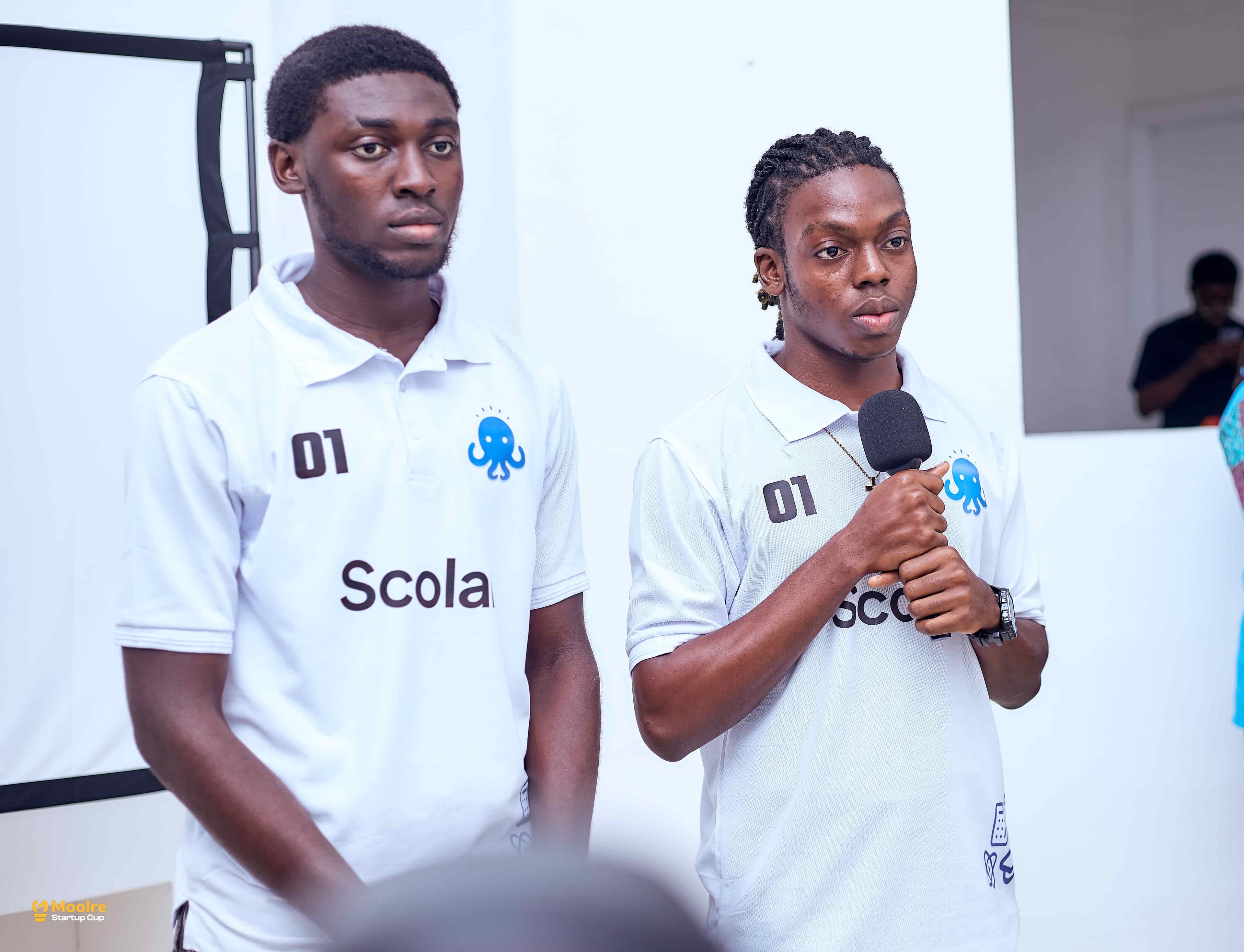
The first version of what is now Scolar worked exactly as designed. Students uploaded their lecture slides, PDFs, and notes to one central place, instead of hunting them down across five apps and a stack of photocopies. They used it. Then, mostly, they stopped.
"We believed organization was the biggest problem," says Bernard Kpakpo Obeng-Sackey, Scolar's founder and CEO. Two months of watching real usage told him otherwise. Students appreciated having their materials centralized. It just wasn't valuable enough to change how they actually studied.
What the First Version Got Wrong
Obeng-Sackey built that first version, then called CourieX, out of his own experience at KNUST, constantly switching between lecture slides, PDFs, YouTube explainers, AI chatbots, and classmates just to understand a single topic. His co-founder and design lead, Henry Osafo Asare, describes hitting the same wall as a student, adapting to a scattered system that was already the norm by the time he arrived at university.
Both founders land on the same explanation for why the fragmentation persists industry-wide: every existing tool solves one narrow slice of studying, explaining, quizzing, organizing, and none of them connects to the others. Connecting them has always been left entirely to the student. Building something that "genuinely teaches" across all of it at once, Obeng-Sackey says, is a materially harder problem than shipping another study app or another chatbot, which is exactly why nobody had done it.
What Scolar Actually Does
A student uploads lecture slides, notes, or PDFs, and an AI explains concepts, answers questions, and generates quizzes, flashcards, mind maps, podcasts, and data tables, all grounded in that student's own material rather than generic knowledge. Students can work through material together in shared study spaces, quizzing each other and discussing concepts. The goal, Obeng-Sackey says, is for a student to spend an entire study session inside one connected environment instead of jumping between disconnected tools.
The harder engineering problem sits underneath that experience: an AI pipeline that takes unstructured material, slides, PDFs, scanned notes, images, transcripts, and turns it into something reliable enough to teach from, while keeping the system fast and affordable to run across every output format at once. Asare's hardest technical challenge sat on the other side of the same product: redesigning Scolar's entire interface so using it felt intentional rather than assembled, a design problem as much as an engineering one.
The Moolre Layer
Scolar integrated Moolre's Collection API to handle subscription payments inside the app. Both founders describe the integration as smooth, clear documentation, no major roadblocks, with Obeng-Sackey pointing to the first successful payment going through as the moment it clicked that Scolar could offer seamless payments without building its own infrastructure from scratch. Without Moolre, the fallback would have been Paystack. The feature they'd want next: broader payment method support, including international cards and bank accounts, as the platform reaches students beyond Ghana.
The Pivot
The moment Obeng-Sackey came closest to giving up was watching that first version's retention numbers come in, months of work behind something people weren't returning to. What kept him going was that the underlying problem was still real; he'd lived it himself, and he was committed to solving it even if, at first, he was the only one still using it. The team rebuilt around that conviction, and Obeng-Sackey names the pivot itself, choosing to rebuild rather than walk away, as the decision he's proudest of over the past year.
What's Next
Obeng-Sackey pushes back on a few assumptions he thinks weigh unfairly on founders building in Ghana: that a startup needs a once-in-a-generation idea, that it has to be built abroad to matter, that meaningful funding has to arrive before real building can begin. His own path argues the opposite: an ordinary problem, tackled directly and rebuilt without ego when the first attempt missed, mattered more than any of those preconditions. His teammate credits him with pushing past thinking of the product as "just a university project"; Obeng-Sackey credits a friend, Eleoera, with pushing him the same way when he doubted it.
Scolar pitches live in the final stage of the Moolre Startup Cup, with winners announced at the Grand Finale on August 29, 2026.